To catch a swarm

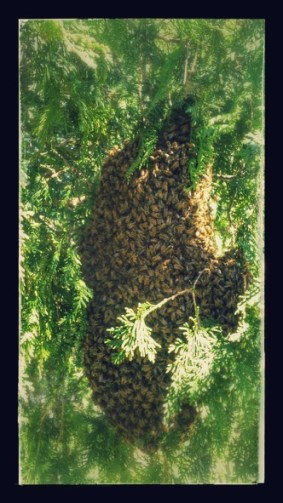
The beginning of May is also the beginning of swarm season. Hilariously, we posted a note to one of our neighborhood social websites early in the morning informing that if anyone sees a bee swarm, to please contact us, and we’ll remove it for free. A few hours later, this was found in our own tree.
18449437_10212519491438906_3494844729620512743_o (2)

Swarms are inevitable, and we’ve been fortunate enough to witness at least one per year. It’s fortunate because it is one of the most mesmerizing things to see. We knew a swarm would happen soon, as we noticed that one of our hives was in the process of creating 2 new queens. We decided to try splitting the hive and creating a new one. This could create a couple different scenarios. Ideally, with a lot of luck, the original hive would decide not to swarm.  That would result in having the original hive with a new colony being created. Sadly, the queen made up her mind, and decided they have to take off anyway.

When bees swarm, their first stop is not far from the original hive. Typically, they stay in one large clump for up to 48 hours. All swarms that we have witnessed from our hives have landed about 40 feet high up in a neighbor’s tree, completely unreachable, and then they leave for their new “permanent” home within 5 hours.

You can see where our hives are located. The swarm landed right where this beekeeper is pointing:

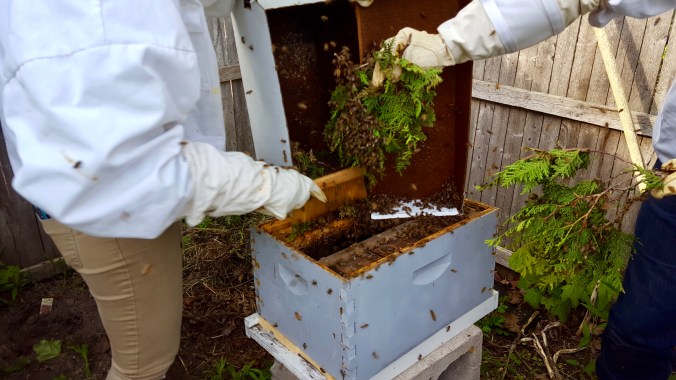
fullsizeoutput_a7dAs a first time swarm catcher, he asked for some advice, but ultimately figured it out on his own. The bees were attached to a branch, so the branch had to be cut off. The girls were placed into a cardboard nuc box, and then we began the fun process of installing them into a deep super.fullsizeoutput_a7bWe provided them with some food, a few empty frames, and hoped for the best.
IMG_0219

Interesting fact: Swarming bees are harmless. Be nice.

Besaw’s Bee Balm and the people that like us

We owe a million thanks to our friend Allie Schnurr and my dad. We started messing around with a consistent recipe for bee balm, and with that we entered the stressful realm of creating lip balm labels.

We wish it wasn’t so difficult to come up with a decision. We wish we didn’t have to put an address on them. We wish we didn’t torture Allie by changing her free “favor” into a free job. And we are very grateful that my dad was willing to mess around with his printer, use up his ink, and drive to and from our house a bunch of times.

The labels were brought to a group of brutally honest 5th and 6th grade students who gave feedback which influenced more changes. We ended up choosing this one for our peppermint flavored Besaw’s Bee Balm. 18360848_10100229564453493_929221017_n

Our friend Robert Frank is letting us set up a mini-display tomorrow night for First Friday at the Hungerford Building. We’ll be on the 3rd floor from 6-9pm. Stop by and check out local artists, buy some stuff, and maybe buy some Bee Sauce or Bee Balm from us!

Save

Feed the bees and give them a drink

Part of the whole “Save the Bees” thing is making sure they have food and water. But it’s nature! They can feed themselves, right? Wrong. At least not all the time. If it’s a particularly nice day- temperature is above 50, there’s a calmness in the air, and no signs of an upcoming storm; then the bees are ready to work. They will fly out in search of pollen and nectar, and bring it back to feed the brood. Unfortunately, there is less pollen in early spring, and there isn’t enough food to go around for all of the ladies. This is where bee food comes in. At this time of year, we feed the bees sugar syrup- 1 part sugar, 1 part water. They can suck up a gallon of this stuff in a little over a week.

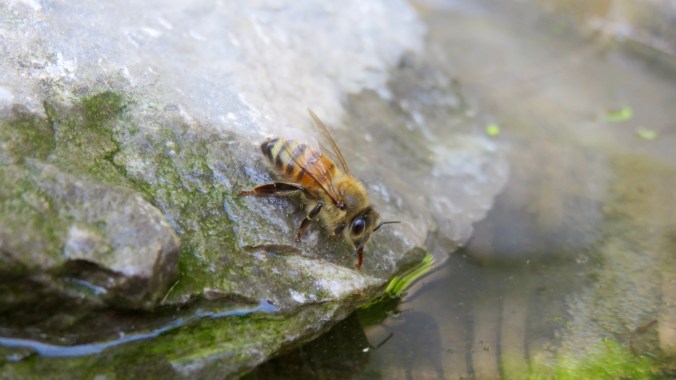
I don’t expect other people to be ready with sugar water for your local bees, but having accessible fresh water is a great thing. Bees become easily dehydrated and may seek out water in less than pleasant places- like your pool, if you have one.

Bird baths are great for both birds and the bees. Put a couple rocks in there for them to land on and watch them drink. Then, pat yourself on the back for helping save the bees.fullsizeoutput_7af

Honor thy queen

Our new Carniolan queen has been accepted! We named her Queen Ruth.fullsizeoutput_a5dWe made this 2 minute visit only to remove the queen cage. Every time we go into the hive and mess around with the frames, we set the worker bees back a few days.
Within this time we were able to see that Queen Ruth is busy building her brood. Her ladies are hard at work and have already filled up some honey frames in the second deep super.

Interesting fact: Queen bees can lay up to 1500 eggs per day.

Package bee installation

Have you wondered how new beekeepers get bees in the first place? Many people have asked if we just set out some boxes and hope to lure them in. If only it were that cheap and easy!

In previous years we installed nuclear colonies, or nucs, which we can talk about some other time. This was our first time getting package bees. Occasionally you might find a company that will literally mail these to you for pick-up at a local post office. Most likely, the postal workers won’t appreciate it. We ordered these through a local business and picked them up in Canandaigua last Saturday afternoon.

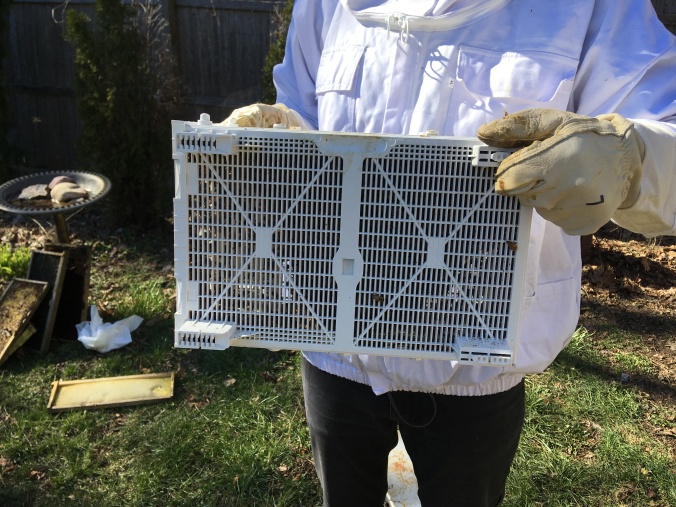
The package bees came in a well-ventilated plastic box. Within this box was a can of sugary syrup, 1 caged queen, and 3 pounds of Carniolan bees.IMG_0031First, we followed the advice of several YouTube videos and sprayed the box down with sugar water. This helped the bees concentrate more on eating and cleaning each other off rather than attacking a potential enemy.
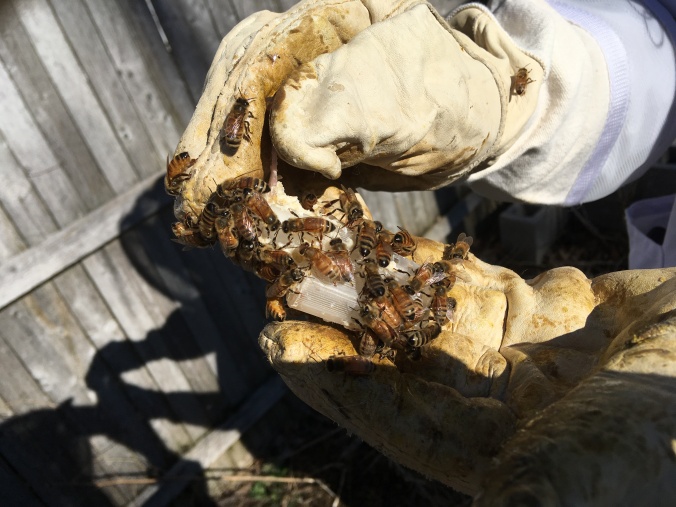
Next, we removed the can of sugar water and searched for the queen cage. This is what it looked like when we found it. The worker bees either really like her already, or they just want to eat the sugar candy.

IMG_0034

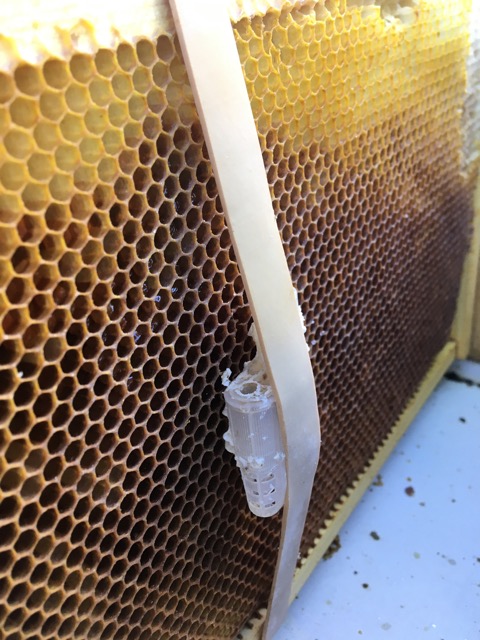
We picked out a mostly empty frame from last year and strapped on the queen cage with a rubber band. There is “candy” inside that hole you see at the top of the cage which keeps the queen inside. The worker bees will eat the candy, and will eat their way through it until they come face-to-face with the queen. The idea here is that they are given time to get to know her highness, and will hopefully respect her enough to accept her as their queen.

IMG_0035

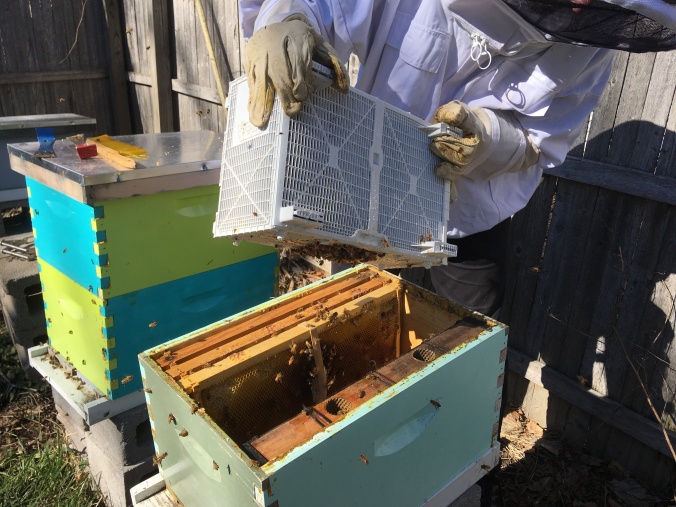
Next came the fun part. We turned the box over and shook them out of the package until the majority of them were in the deep super. It took a lot of shaking- you’d almost believe they wanted to live in that plastic box forever.IMG_0040

We plan to quickly open up the hive this weekend so that we can remove the rubber band and queen cage.

Here is a link to a very brief video of the seemingly violent shaking that had to be done to get the bees out of the package.

Shaking in the bees

Interesting fact: Carniolan bees are more prone to swarming, so this should be fun.

Save

Save

God save the queen

We did the spring inspection before picking up our new girls today. I knew they were active, but I was pleasantly surprised at how well they were doing. Those are some worker cells in the top left of this first photo. Can you find the queen?

fullsizeoutput_a4fThere she is! She is seriously beautiful. Look how all of her workers are doting on her.

fullsizeoutput_a51We had to pick up our package bees this afternoon, which meant we needed to clean out one of our dead hives. I chose this one. This is what it looks like when a colony starves over the winter.
fullsizeoutput_a53

Starvation causes them to drop directly to the bottom board. What was extra gross about this one, is the hive was tipped back a little due to the ground settling, and water gathered in the back of the bottom board. The scent of dead, moldy bees was absolutely foul. They sure had enough honey- in fact we are extracting honey from a few of the full frames they left behind. This was a weak colony, and I was not expecting them to survive.

Interesting fact: I did not get stung today, but I should have with all the time I spent harassing them.

Save

Save

Save

Not a lazy Sunday for these ladies

fullsizeoutput_a3fThe weather is beautiful, and I had all intentions of doing a spring inspection of our sole surviving hive today, but I pushed it off until it was too late in the day. They are still flying in and out and gathering pollen at 6:30pm, but it is best not to disturb them after 5. This is advice I was given through books, various speakers, and tested with my own stubborn experience. They just want to be left alone after a hard day’s work.

Aren’t they cute?

Save

Save

Never ending tribulations of beekeeping

This is a pricey hobby. $3,152.63 has been spent on beekeeping supplies since 2014, and we’ve only made about $220 selling honey.

The summer of 2016 began with 4 strong hives. By November there were 3 weak hives, and now spring of 2017 we are starting off with 1 hive which seems to be doing okay. So 75% of the bees didn’t make it, which sadly, is typical.

I know what killed them. The strongest hive took off, or absconded, in the fall because it failed to produce a new queen after its July swarm. The second strongest hive died from starvation- a brief change in temperature over the winter got them to be more active, and they didn’t have the energy to crawl 5 centimeters up to their stored honey once the cold returned. The weakest hive died because of their strength in numbers. They produced no supplemental honey last year, so this was no surprise.

This beekeeping season begins with a goal in mind. We want to begin overwintering nucs and attempt queen rearing so that we can end the cycle of having to buy new queens each year.

Interesting fact: Colony Collapse Disorder was NOT the cause for any of our hives, ever, to die.